
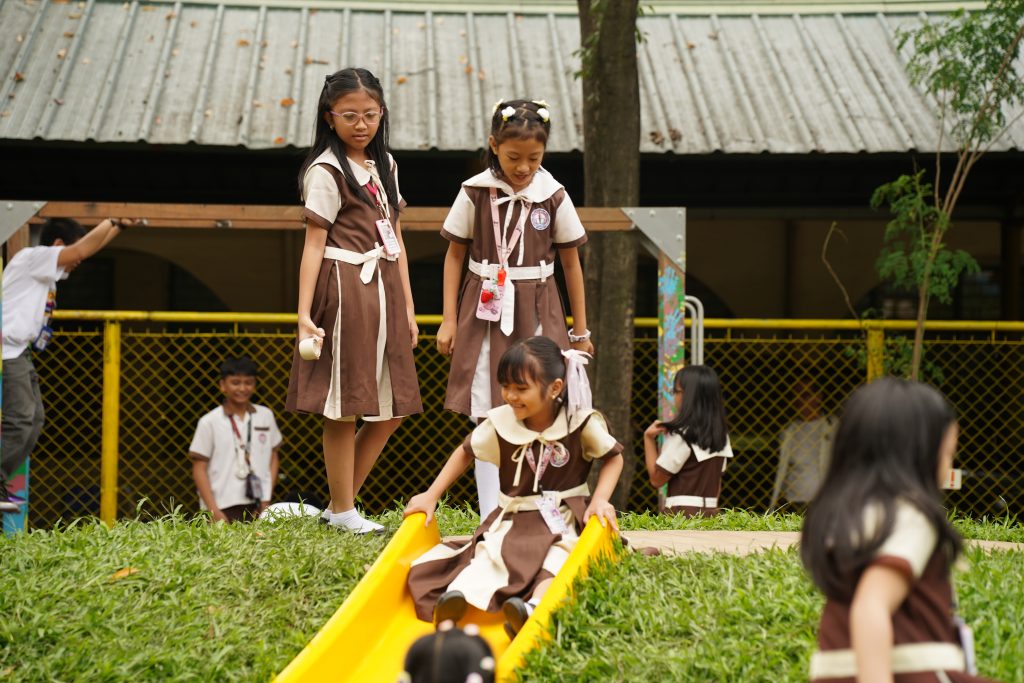
Extreme heat makes schoolyards in Quezon City too hot to play in and shortens playtime. Through the OASIS Schoolyard Programme, R-Cities partnered with Temasek Foundation, students, teachers, city officials and design experts to transform asphalt into greener, cooler spaces across three public elementary schools. Today, more than 15,000 students benefit every day from space to play, rest and learn outdoors.
Every school followed the same four steps:
- Listen: Students and teachers shared their daily challenges. Placemaking experts turned them into clear needs.
- Imagine: Students and teachers drew and modelled ideas. A landscape designer turned them into safe, climate-responsive options.
- Decide: The school, the city and the designers agreed what to build, then shared the design with parents through an exhibition.
- Build: Students and teachers worked with the contractor to plant, paint and build.
The method stays the same, and each design answers its own site. These profiles show the physical changes and local impact at each school.
Across the three schools
- 114 students serve as OASIS Ambassadors
- 2,351 sq m redesigned
- 15,945 students benefit every day
- 730 new trees, shrubs and plants
Quezon City is now extending OASIS to three more schools. OASIS is part of R-Cities’ place-based resilience work, where resilience solutions are proven at the community level.
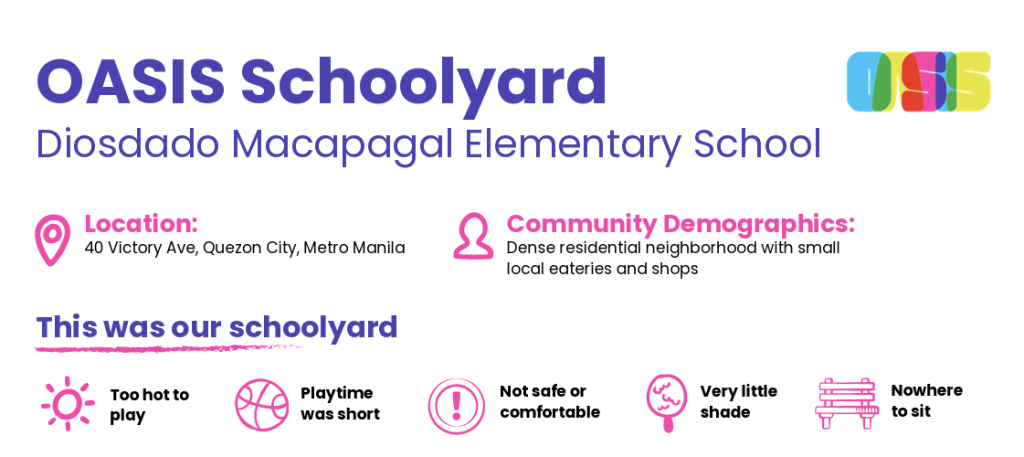
Diosdado Macapagal Elementary School:
1,400 sq m of greener schoolyard, including a 560 sq m playground. 1,650 students now hold outdoor classes every week.
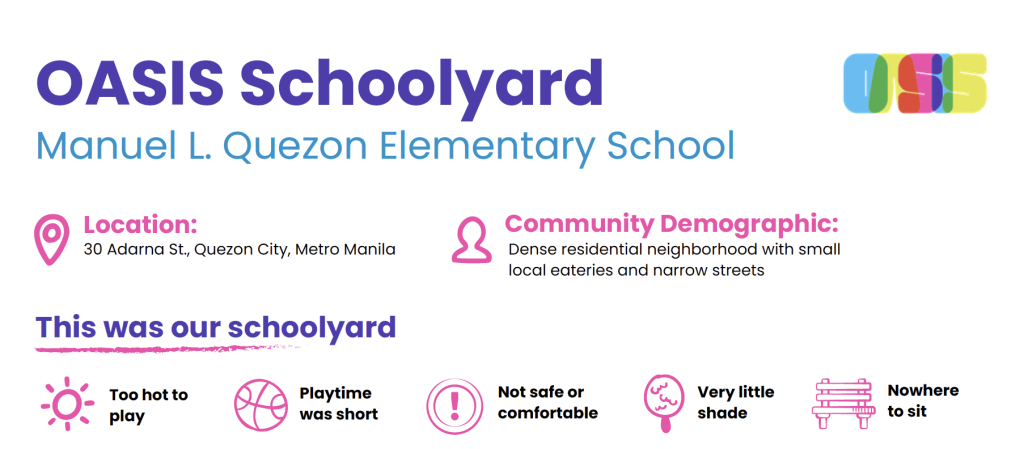
Manuel L. Quezon Elementary School: 643 sq m redesigned for 7,506 students. A space once dominated by cars is now a meeting place, with an outdoor blackboard, new seating and an insect hotel.
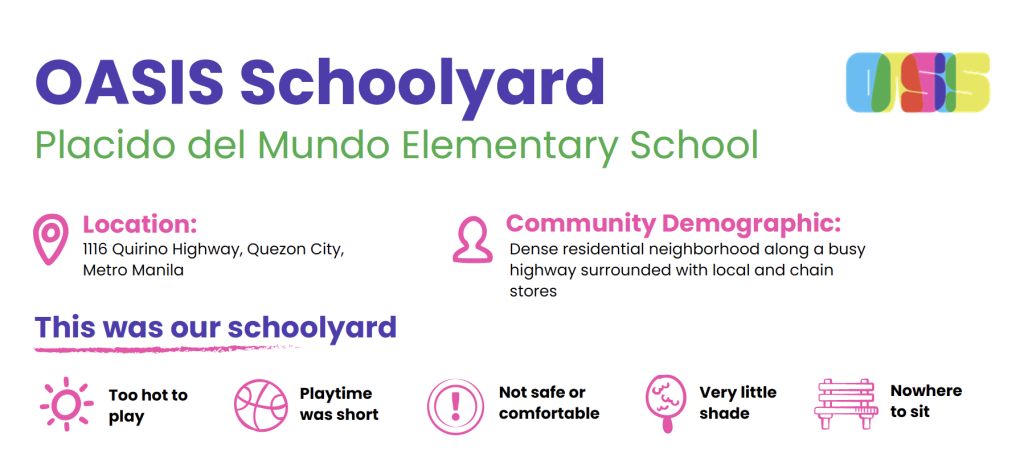
Placido del Mundo Elementary School: 308 sq m beside the library, now shaded by 6 m sails and used by 3,980 students for reading and gathering.