
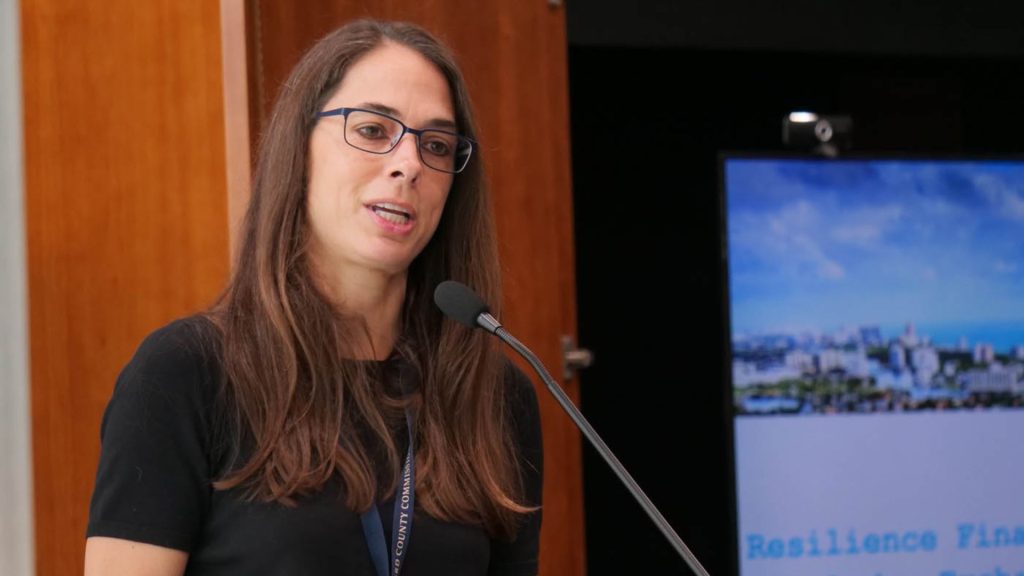
Broward County’s Chief Resilience Officer on translating water science into policy, billion-dollar resilience investments, and convening partners across jurisdictions to protect South Florida’s communities and economy.
Dr. Jennifer Jurado didn’t begin her career thinking about multi-billion-dollar infrastructure projects. When she earned her Ph.D. in Marine Biology and Fisheries from the University of Miami, she was focused on ecosystems and the interplay of water and life in South Florida. But after two decades with Broward County, her role has evolved into Deputy Director of the Public Works and Environmental Services Department and Chief Resilience Officer, overseeing fourteen divisions from natural resources to water utilities to bridges and highways. She explained to us how treating these as systems, and nurturing the partnerships at their heart, is how she approaches resilience in her work.
Broward County, located in South Florida’s Miami metropolitan area, is Florida’s second-most populous county with nearly two million residents. With Fort Lauderdale as the county capital, the coastal region is bordered by the Atlantic Ocean to the east and the Everglades to the west, a geography that makes water management central to everything.
“As a young person, going through high school and university, I was very interested in ecology and science,” Dr. Jurado reflects. It was a mentor early in her county career who shifted her trajectory. “She said to me, ‘Jennifer, if you really want to influence long-term change, you have to affect policy.'” That insight transformed how Jurado approached her work: technical expertise needed translation into policy frameworks that could outlast individual initiatives and become woven into government.
After completing her Ph.D., Dr. Jurado joined Broward County in 2002 as Water Resources Manager, just as a Comprehensive Everglades Restoration Plan was being implemented. “It became very clear early in my career that when we thought about climate change, the implications were really about water in our community. And it would affect all facets of water management.”
Over the next two decades, Dr. Jurado’s responsibilities expanded from water resources to encompass all climate work for the county, eventually becoming Director of Environmental Planning and Community Resilience with the formal Chief Resilience Officer designation.
When Dr. Jurado talks about building resilience in the county, she has several major projects to cite – projects spanning decades and partnerships at every level of government. Take the Section 203 Flood Control System for example, built in the 1940s and in desperate need of an upgrade in the face of rising sea levels.
After 15 years of advocacy, Dr. Jurado secured federal authorization and funding for a study, to be completed in May 2026, providing recommendations for a $1.8 billion improvement project. The project required partnership with the Army Corps of Engineers and cost-sharing with the South Florida Water Management District, as well as highly complex coordination across federal, state and county entities. “These are such heavy lifts to advance the large-scale studies and projects required to address massive infrastructure investments that are needed. And we can’t do that on our own,” she explains.
This pattern of multi-jurisdictional coordination has become a defining characteristic of her career. “You really have to be dedicated to those projects, and you have to be able to carry them through because they cross tenures of many staff and leadership,” she notes. These are the kinds of efforts that require not just technical knowledge, but political translation and persistent relationship-building.
Dr. Jurado talks us through the C-51 Reservoir: 16 years and $160 million to complete South Florida’s first regional water resource development project of its kind. “It was a project that nobody could afford on their own, but the benefits were so great that it warranted the participation of many.” She was a principle shepherd of the entire effort – convening drainage management districts, municipalities, and water utilities – through political challenges that outlasted multiple staff and leadership tenures.
Next up was the development of a countywide Resilience Plan, representing another multi-year, broad community engagement effort. The business community’s demand for “real solid economic metrics” shaped Broward County’s approach to this 50-yr Resilience Plan which Dr Jurado also led, demonstrating how it will protect $30 billion in residential property value, avoid $4 billion annually in flood damage and contain rising flood insurance costs, preserving $20 billion in coverage. But the total price tag – $28 billion, with $9 billion in public costs – required new thinking about climate financing.
“It’s really helpful to say: other communities that look like me in these coastal environments are also dealing with similar challenges,” reflects Jurado of the value of the R-Cities network.“We’re not the only ones. And guess what? They’re also having to look at investments on the scale of 10, 20, 30 billion dollars,” she explains. That peer learning provided political legitimacy – when astronomical costs are normalised across multiple coastal cities, they become manageable conversations. “We don’t need to be afraid in terms of talking along those terms.”
Leading such efforts through so many years requires what Jurado calls “staying power” – not just technical knowledge, but personal resilience. “You really have to be dedicated to those projects,” she reflects.“Those are the kinds of really rewarding things to be able to celebrate in your career, I think.”
The motivations of Dr. Jurado’s work haven’t fundamentally changed from when she started; it is rooted in water systems, climate impacts and ecological health. Her perseverance in Broward County has enabled her to shepherd transformational projects over decades, sustaining partnerships at every level of government and beyond.
“Every one of the projects that we’ve been successful on has been by virtue of extensive collaboration,” she concludes. “They have to be nurtured all the time. You need to stay connected. You need to stay in communication…It has to be a priority.”