

Community of Practice Issue Brief #4
Mental health is fast becoming one of the most consequential, and most overlooked, dimensions of urban climate risk.
Unlike acute physical impacts such as injury or disease, the mental and brain health toll of climate change is insidious. It compounds quietly in the background, eroding social stability, community cohesion, and economic productivity long after an extreme weather event has passed. This creates a fundamental challenge for city leaders: how to justify investment in climate adaptation and mental health before the costs become visible.
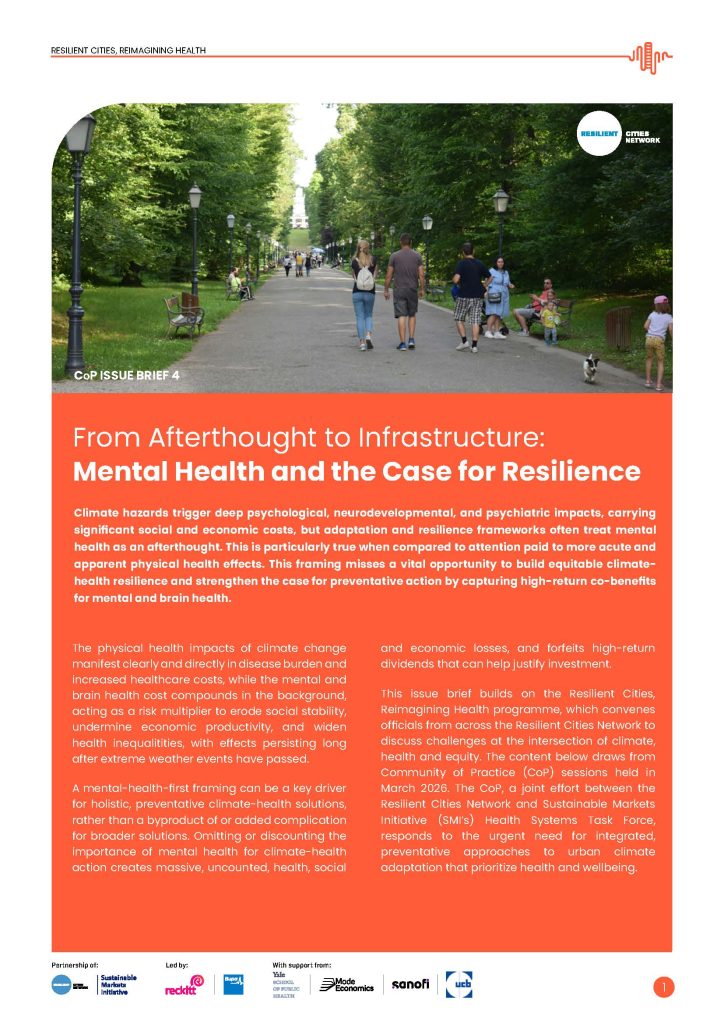
This Urban Pulse Issue Brief explores how cities can overcome that barrier. Drawing on insights from the Resilient Cities, Reimagining Health Community of Practice, it outlines practical approaches to embed mental health and psychosocial support (MHPSS) into climate-health planning and strengthen the case for investment.
The evidence is clear: interventions cities are already pursuing, such as tree canopy expansion, home insulation, and low-emission transport zones, deliver measurable mental health returns without requiring additional fiscal allocation. Yet progress depends not only on solutions, but on how they are framed.
What cities need now is a mental-health-first framing: one that builds the investment case with data, bundles co-benefits into the business case, and designs engagement around identity and quality of life rather than alarm. Dive into our latest climate and health issue brief:
The Resilient Cities, Reimagining Health program is a partnership between the Sustainable Markets Initiative Health Systems Taskforce and the Resilient Cities Network, led by Bupa and Reckitt, with support from the Yale School of Public Health, Mode Economics, Sanofi and UCB. This first-of-its-kind global coalition of over 30 cities, alongside healthcare companies, academics and the private sector, is working to understand cities’ priorities and the barriers they face, and to develop the tools and resources required to help overcome the increasing threats that climate change poses to the health of the population and health systems.