It’s hard to keep up with so much noise. But cities and their Chief Resilience Officers are not flinching. They have been building plans, testing solutions and mapping what works across governance, finance, health and neighbourhoods long before today’s shocks.
The context is more challenging than ever. But cities have been building the practice to meet it.
What 100+ practitioners across 45+ cities are telling us: the solutions exist, they are being delivered, and the moment calls for taking them further.
In our second Cities on the Frontline session of 2026, we heard from practitioners on what it takes to move resilience from strategy to implementation and scale.
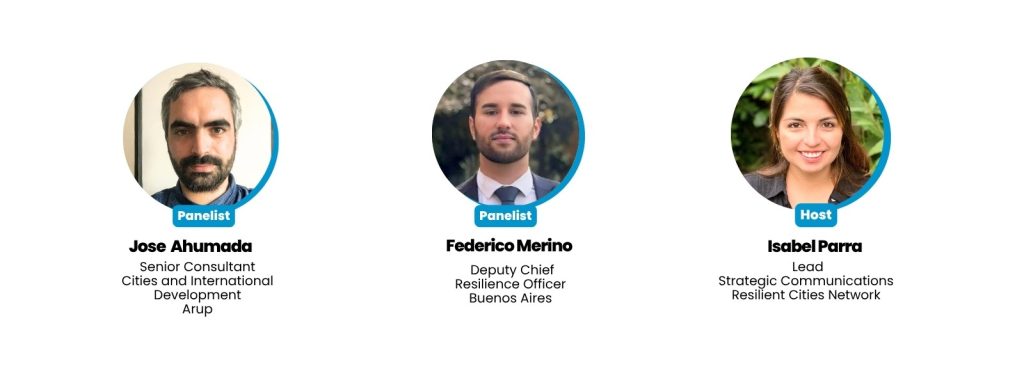
- Jose Ahumada, Senior Consultant, Cities and International Development, Arup, explored how resilience practice is evolving, from planning for what could change and adapting approaches to local contexts, to connecting long-term planning with investment and delivery.
- Federico Merino, Deputy Chief Resilience Officer, Government of the City of Buenos Aires, shared how political and institutional realities shape what cities can deliver, including competing priorities, budgets, political cycles and the need for stronger coordination and evidence.
- Moderated by Isabel Parra, R-Cities, who brought these perspectives together around what it takes for cities to learn from what works and take proven approaches further.
The conversation also explored how networks and peer learning can help cities share experience and strengthen resilience practice within and across cities, drawing on the Practitioners’ Call to Scale and City Solutions Map.
Listen in!