

By Lina Liakou and Katrin Bruebach
Co-Managing Directors, Resilient Cities Network
Cities taught us that resilience works.
When we started working together, resilience was a word cities were still learning to use. One of us was deputy mayor of Thessaloniki, leading the city’s first resilience strategy in the middle of an economic crisis. The other was a civil engineer working with governments across Africa and the Middle East to strengthen urban water and sanitation systems and ensure they served the people who depended on them most. We came to the same problem from opposite ends, the policy and the systems, and we both watched resilience go from a word in a strategy document to the way cities manage uncertainty and decide.
What was once a single officer with a strategy is now a function embedded across city government. Chief Resilience Officers connect departments, shape investment decisions and sustain long-term priorities beyond political cycles.
The question has changed with them. Ten years ago it was why cities should invest in resilience. Today it is how to expand and sustain what already works.
To define our new strategy, we listened. To cities, Chief Resilience Officers, partners, funders, our team and our Board. Three things kept coming back.
1. Cities are further ahead than the systems built to support them
We went looking for good practice. We found maturity and mastery.
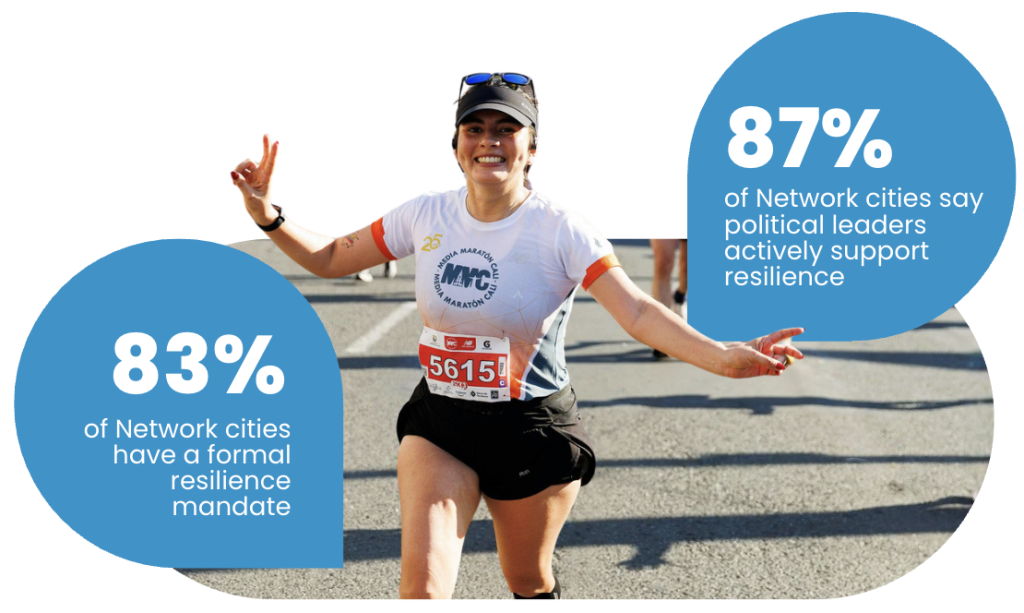
Cities have stopped testing whether resilience works and started building it into how they govern. What began as strategies and dedicated resilience offices has become part of how cities make decisions.
Across our network, cities are already integrating resilience into planning, investment, public health, neighbourhood development, and day-to-day decision-making.
We saw this most clearly as we prepared for the network gathering in London last December. Working with cities and practitioners across the resilience community, we set out to map the solutions already being put into practice.
The depth of it surprised us. In Paris and Quezon City, schoolyards designed around heat adaptation are doing more than one job at once: cooling neighbourhoods, creating public space, strengthening community life and supporting public health. In Cape Town, resilience teams are integrating geopolitical risk into how the city prepares for cascading disruptions. In Rotterdam’s BoTu district, resilience is being built through long-term neighbourhood transformation that brings together social cohesion, housing and climate adaptation.
The examples were diverse. The pattern was not. Cities know what works.
2. The challenge is no longer innovation. It is scale.
What struck us was not how much the practice had evolved. It was how often the systems around cities had failed to keep pace. Funding comes in short cycles. Knowledge sits in silos. Capital and outcomes rarely meet.
Cities are asked to keep innovating when what they need is the means to scale, adapt and sustain what already works. The gap matters more now than it did five years ago. Heatwaves have now overtaken floods as the shock cities report most. Political volatility is reshaping long-term planning horizons. Fiscal pressure is rising.
The question for us is no longer whether resilience can deliver results. It is whether the ecosystem around cities can match what they have built at the scale this moment demands.
3. We must evolve from convening to scaling.
For years the biggest value of our global network has been the connection itself: a space where Chief Resilience Officers can meet, compare experiences and trust each other. That mattered, and it still does. But If cities are already proving what works, our role can no longer focus primarily on building the field. We must help proven city-led solutions travel further, faster, and more effectively.
The shift is simple, but significant: from building a network to scaling what that network makes possible.
For over a decade, cities and CROs have built one of the most connected global communities of urban resilience practitioners anywhere in the world. They have developed trusted relationships, shared experience across regions, and demonstrated that resilience can move from strategy into implementation.
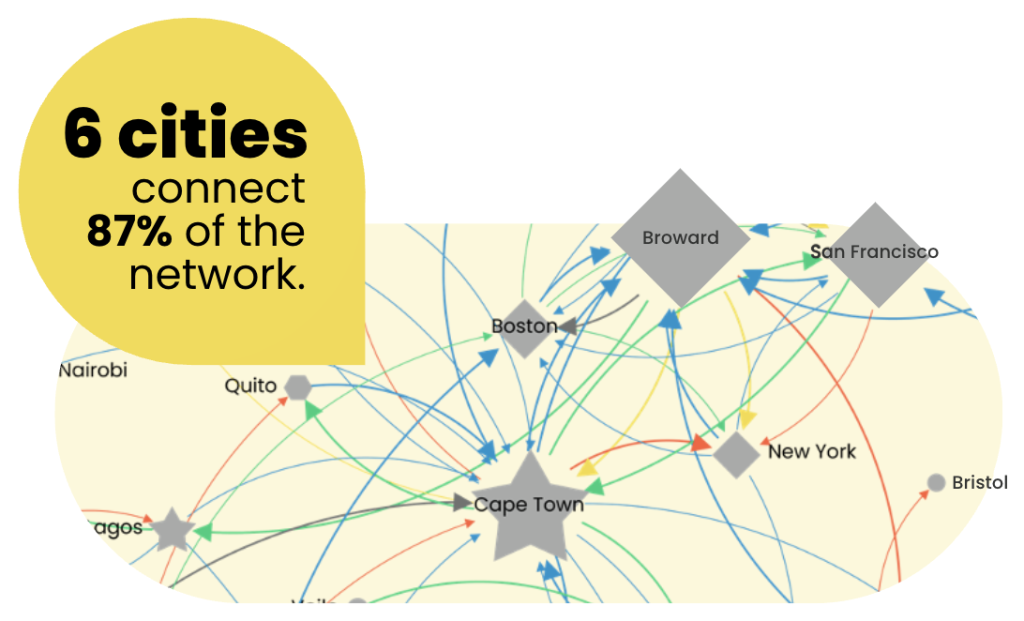
But connection is not the same as scale. A solution that works in Boston does not reach Lagos because two officers had a conversation. It travels when someone builds the path: the funds, the evidence, the adaptation to a new context, the institutional backing that lets a proven practice take hold somewhere new.
That is why our new strategy focuses on three interconnected areas.
The first is place-based resilience. This is where resilience becomes tangible in people’s everyday lives: in schools, neighbourhoods, public space and the infrastructure that holds daily life together.
The second is resilience and health. Again and again, cities pointed us to health as the place where resilience becomes most visible. It is where climate pressure, inequality, inadequate housing, ageing infrastructure and economic stress converge. It is also where the value of resilience becomes tangible to communities, institutions and investors alike.
The third is the institutional backbone: leadership, capacity and finance. Cities carry resilience through strong institutions, leaders who work across silos and financing that treats resilience as part of how they invest and govern rather than an add-on. Strengthen the backbone, and place-based and health work scale further and faster.
We can do this because the foundations already exist. A decade of work built one of the most trusted global communities of resilience practitioners anywhere. Solutions move through those relationships and the relationships are already there. Scale can be designed. That is what our 2030 strategy sets out to do.
Resilience rarely holds when expertise sits in one place. It depends on collaboration, trust and institutions that can adapt under pressure. That lesson has shaped how we approach leadership at R-Cities. We believe co-leadership reflects the kind of institution this moment requires: one that can hold different perspectives, work across boundaries, and stay focused on the outcomes cities are building.
We have spent much of our careers working alongside cities and governments. We have seen how far cities can carry it when the systems around them hold and how much is lost when they do not. Cities have done their part. They have shown what works. What remains is for the rest of us to make sure it reaches the people who need it. That is the work we are taking on, and it is why this moment matters to us.